Short answer: yes. Long answer: here's how it works
SpaceX is perhaps the clearest illustration of why interest in unlisted shares has grown so dramatically. With a valuation that reached $800 billion in December 2025 – and banks projecting an IPO valuation of $1.5 trillion – SpaceX is one of the world's most sought-after investment opportunities. But the stock isn't listed on any exchange.
Even so, it is possible to buy SpaceX shares as a private individual in Sweden. It happens via the secondary market for unlisted shares, where existing shareholders sell parts of their holdings to new investors. Accumeo is one of the platforms that makes this possible.
SpaceX by the numbers – why the company is unique
SpaceX is a conglomerate with three distinct business legs that all generate significant revenue.
Starlink – satellite internet. Starlink has grown from 10,000 beta users in 2021 to over 10 million subscribers in February 2026, active in more than 100 countries with roughly 9,500 active satellites in low Earth orbit. Revenue was estimated at $10–12 billion in 2025. Consumer subscriptions cost around $120 per month in the US, while maritime services command $5,000 per month and airline solutions up to $300,000 per year. Starlink reached profitability in 2024 and its gross margin is expected to rise from 7 percent in 2024 to 25 percent in 2026.
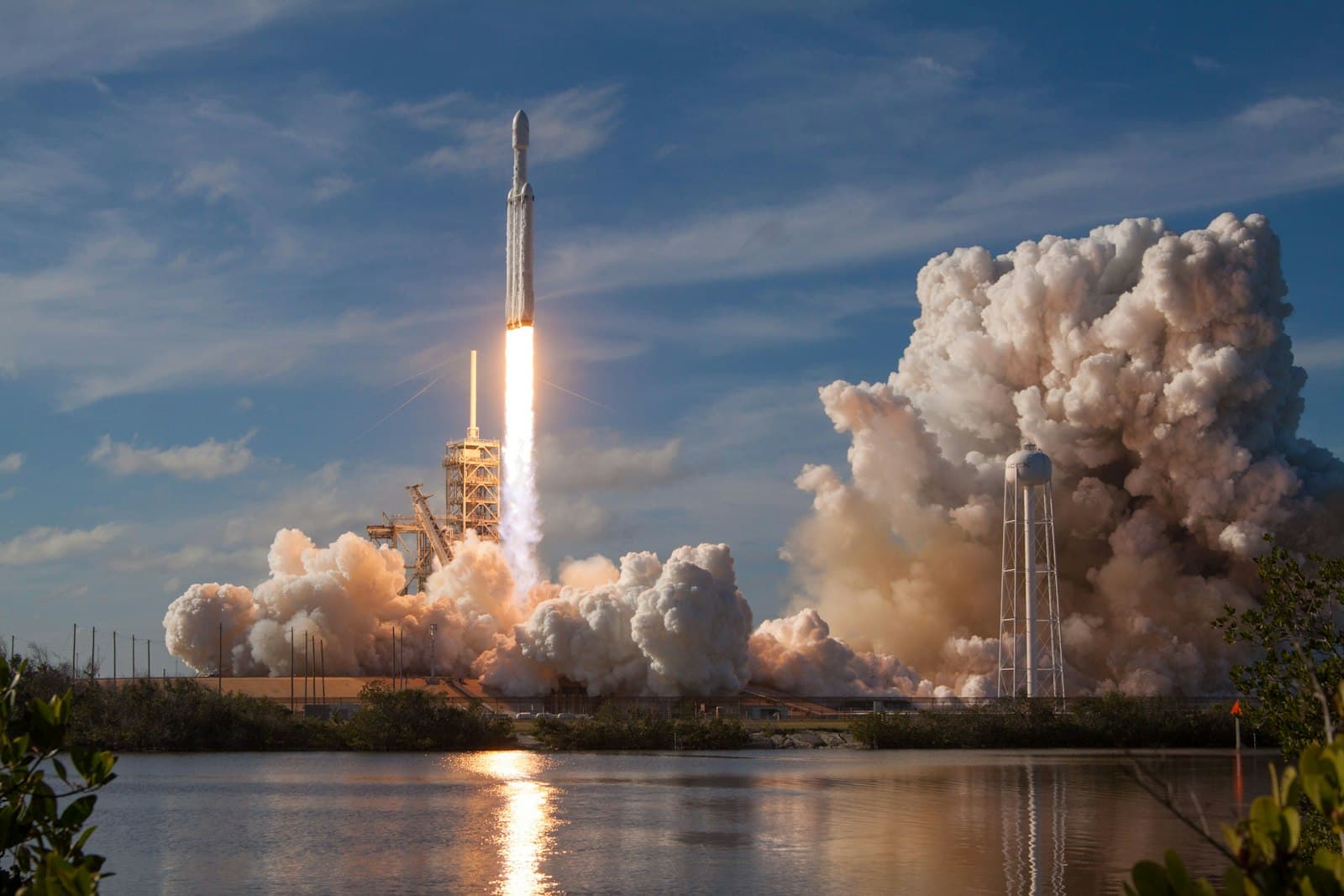
Rocket launches. SpaceX carried out 134 launches in 2024 – more than all other operators combined – and aimed for 170 in 2025. The Falcon 9, with its reusable first stage, has radically lowered the cost per launch. The company controls an estimated 75 percent of the commercial launch market and has secured a Pentagon contract worth $5.9 billion.
Starship – the next generation. Starship is the heavy-lift launch vehicle intended to enable the colonisation of Mars and the next generation of Starlink satellites. In May 2025 the FAA approved an increase in SpaceX's launch cadence from Starbase in Texas from 5 to 25 per year – a decisive regulatory breakthrough.
Financial profile – revenue, profit and growth
SpaceX generated an estimated $15–16 billion in total revenue in 2025, with operating earnings (EBITDA) of $8 billion. That makes SpaceX a company with a revenue profile beginning to resemble the largest listed technology companies.
The revenue mix has shifted dramatically. As recently as 2022, rocket launches accounted for the majority of revenue. Today Starlink dominates, with an estimated 60–70 percent of total revenue – and it is Starlink's recurring subscription revenue that makes the company so attractive to investors. Compared with one-off payments per launch, the subscription model offers predictable, scalable and high-margin growth.
Price development on the secondary market
The price of SpaceX shares on the secondary market has seen dramatic movement. From $185 per share in December 2024 (at a total valuation of $350 billion), the price rose to $463 per share at the end of 2025 ($800 billion). That is a 150 percent increase in one year.
Trading volume in SpaceX shares on the secondary market has also risen sharply. In the fourth quarter of 2025, nearly five times the volume observed in the third quarter was recorded, making SpaceX the most traded unlisted share.
IPO speculation – what we know
Elon Musk has repeatedly said that a SpaceX IPO is likely once "revenue growth is stable and predictable". Given SpaceX's current growth rate and profitability, many analysts believe that criterion is now met. Banks have begun to estimate a potential IPO valuation of $1.5 trillion – which would make it the largest stock-market flotation in history, by a wide margin.
Risks specific to SpaceX
Technical risk: the Starship programme is technically extremely demanding. Delays or failures could affect the valuation.
Regulatory risk: SpaceX depends on regulatory approvals from the FAA and FCC. Regulatory changes, particularly around spectrum rights and environmental permits, could affect operations.
Concentration risk: the company is strongly tied to Elon Musk personally. His other commitments (Tesla, X, xAI, DOGE) and his public profile represent a kind of key-person risk.
Competitive risk: Amazon's Project Kuiper plans to challenge Starlink, even if SpaceX has a massive head start. Kuiper must launch 1,600 satellites by July 2026 to keep its FCC licence.
Valuation risk: at a valuation of $800 billion, SpaceX trades at roughly 50 times revenue – considerably higher than traditional telecom companies, which trade at around 8 times. The high multiple reflects expectations of future growth, but also leaves limited room for error.
How to invest in US private companies via Accumeo
Investments in large US private companies such as SpaceX, OpenAI and Stripe must in practice be made through so-called SPVs (Special Purpose Vehicles). These are separate companies that pool capital from several investors in order to make a single investment in a private company. In the event of an IPO, the SPV's holding is converted into listed shares in accordance with the listing terms.
Just like other early investors, SPVs are generally subject to a lock-up period, often around 180 days. During this period the shares cannot be sold. The exposure, however, remains unchanged. After the lock-up, the manager may choose to sell shares and distribute the proceeds to investors, or distribute shares directly to investors (an in-kind distribution), if the structure allows it. The method is determined by the SPV agreement and the manager's strategy.
There is no way for an individual private person to buy directly onto these companies' cap tables – the SPV structure is the established standard in the US private market.
Not all SPVs are alike, however. In the industry it is common to see fee models that include both a management fee and performance-based compensation (carried interest), often on the order of 2 percent in annual fees and 20 percent of profits – a structure known as "2/20". Some players also stack fees across multiple layers, which can erode returns considerably.
Accumeo sets up and administers its own SPVs for each investment. We are the only platform in Sweden that offers a 0/0 structure: no management fee and no carried interest. You pay only a fee of 5–10% at the time of investment – we take no share of your profit. That means your entire upside accrues to you as the investor.
We structure investments in accordance with applicable regulations, and you get full clarity on what you own, how the structure works and which terms apply.
If you have questions about how it works, you are very welcome to contact us. If you would like to see which investment opportunities are available right now, you can create an account and explore our platform.